
Web3 services
Although many people refer to TON only as a blockchain, The Open Network is a combination of the following components:
- A flexible multi-blockchain platform with Turing-complete smart contracts (TON Blockchain)
- A peer-to-peer network used by blockchain nodes (TON Network)
- A distributed file storage technology (TON Storage)
- A network proxy/anonymizer layer (TON Proxy)
- A Kademlia-like distributed hash table (TON DHT)
- A service for assigning human-readable names to accounts, smart contracts, services, and network nodes (TON DNS)
- A platform for hosting decentralized websites (TON Sites)
- A privacy routing layer for ADNL traffic (TON Tunnel)
These components compose into a layered stack:
| Layer | Component | Role |
|---|---|---|
| Transport | TON Network (ADNL) | Encrypted peer-to-peer messaging |
| Discovery | TON DHT | Locates nodes and resources by 256-bit key |
| Naming | TON DNS | Maps human-readable names to addresses |
| Content | TON Storage | Content-addressed file distribution |
| Access | TON Proxy | HTTP bridge from conventional browsers to ADNL |
| Application | TON Sites | Web hosting over ADNL |
| Privacy | TON Tunnel | Garlic-routing anonymity layer |
TON Network
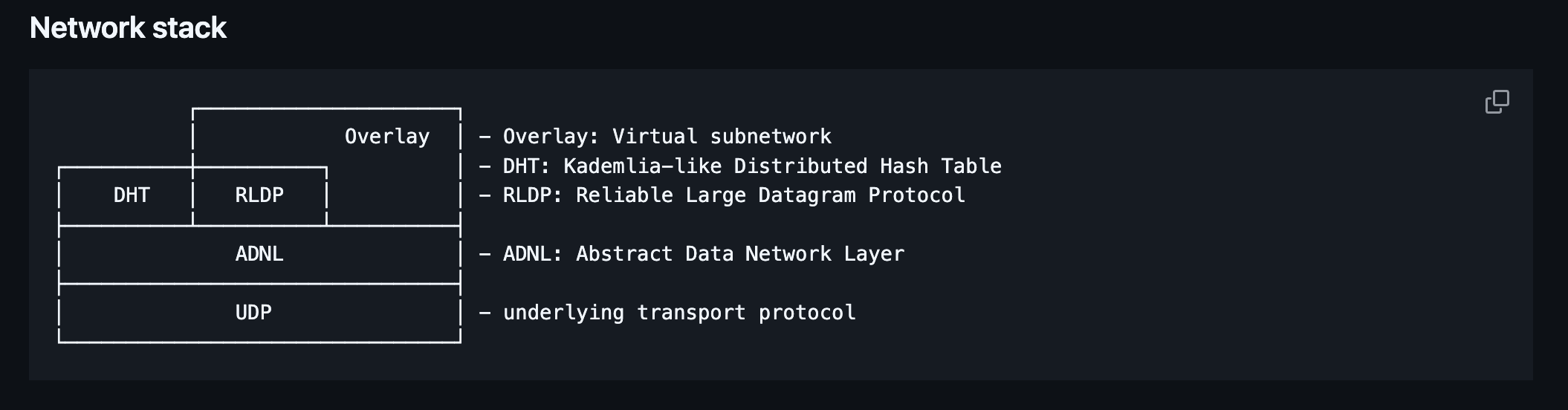
Section titled “TON Network”TON Network is a peer-to-peer network used for accessing the TON Blockchain, sending transactions, and receiving updates. It can also support arbitrary distributed services, blockchain-related or not. The cornerstone in TON networking is the ADNL protocol, built on top of the TCP/UDP stack.
The TON Distributed Hash Table (DHT) is the discovery layer of the TON network, used to locate other nodes. The DHT acts as a large key-value store: 256-bit integer keys, computed in most cases as sha256 hashes of TL-serialized objects, map to arbitrary byte strings of limited length.
TON Storage
Section titled “TON Storage”TON Storage allows users to share and store files using The Open Network. Since storing files on-chain isn’t practical, TON Storage only stores Merkle proofs for file content on-chain. It uses TON DHT to find the nodes that have a copy of a required file (for example, a snapshot of the state of a shardchain, or an old block). One might create a torrent for such a file and use TON DHT as a distributed torrent tracker.
TON Proxy
Section titled “TON Proxy”TON Proxy provides a protocol where nodes wishing to offer their services (with or without compensation) as tunnels for ADNL network traffic can register. Those needing them can then choose one of these nodes based on the price, latency, and bandwidth offered. Since ADNL traffic is encrypted, TON Proxy cannot access tunneled data, making the protocol secure.
TON Proxy enables conventional browsers to visit TON Sites (HTTP over ADNL). Combined with TON DNS and other TON services, this forms what is called “Open Network”.
TON Sites
Section titled “TON Sites”TON Sites are websites hosted on ADNL addresses rather than conventional IP addresses. Visitors reach them through TON Proxy, which bridges standard HTTP requests to the ADNL transport. TON DNS provides human-readable .ton domain names for these sites.
TON Tunnel
Section titled “TON Tunnel”TON Tunnel adds a garlic-routing layer to ADNL traffic. Each relay in the path decrypts only its own instruction layer and forwards the rest, so no single node learns both the sender and the destination. Relay operators can accept micropayments per packet through virtual payment channels.
TON DNS
Section titled “TON DNS”TON DNS is a service that translates human-readable domain names like test.ton or mysite.temp.ton into TON smart contract addresses, ADNL addresses used by services on the TON Network such as TON Sites, and more. The standard is implemented using smart contracts and config parameters.
TON domain names are recognized by wallet applications and block explorers across the ecosystem.
TON Domains can be assigned to any ADNL address, including TON Storage files (bags).